
The complete guide · Preparation
4×4 essentials checklist: load everything, forget nothing
Here is our 4×4 essentials checklist (free download), the one we run through on the Defender 130 before every big expedition. It’s a personal list we’re sharing with you, built out on the trail, meant to be adapted to your destination, season and trip length: desert, altitude, malaria zones and deep cold don’t call for the same load. The point isn’t to carry as much gear as possible, but the right gear, the kind you actually know how to use and that will get you out of a tight spot in the middle of nowhere.
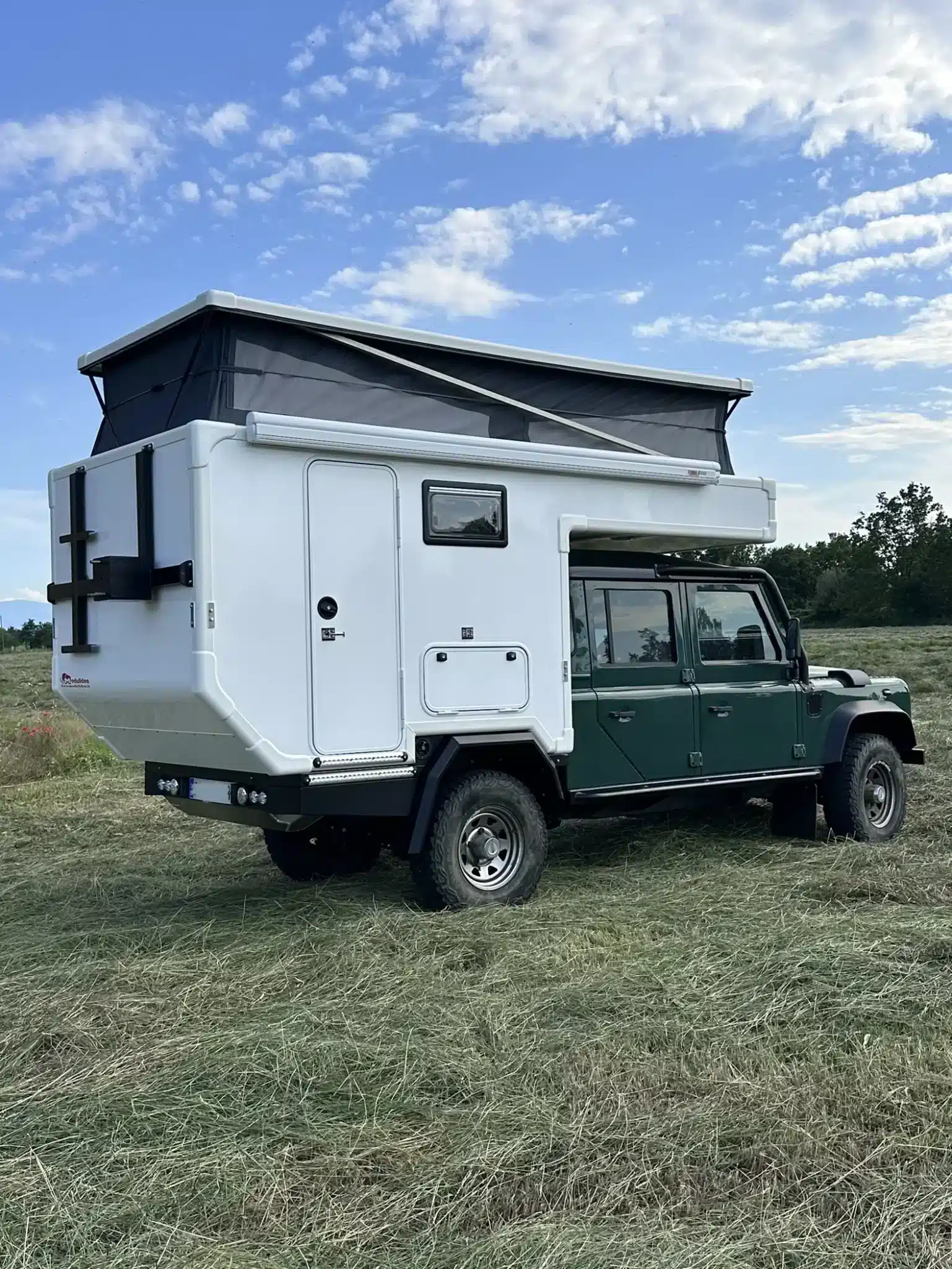
A 4×4 essentials checklist that adapts to the terrain
After years on the trails, we’ve learned one thing: a botched departure rarely comes down to what you pack, but to what you forget. This 4×4 essentials checklist gathers our must-haves, sorted by use, from the toolbox to a well-stocked first-aid kit, so nothing important slips through the cracks.
We built it as a modular list: the same base for every expedition, with a few lines to beef up or trim depending on the country and the terrain.
Some lines flex with the itinerary. Tick, adapt, lighten, but always keep enough to drive, repair and treat yourself in full autonomy.
Drive & repair
4×4 essentials: tools, repair and recovery
The first block of any 4×4 essentials checklist: enough to drive and fix things on your own, without depending on a garage hundreds of kilometres away.
Tooling
Tooling is one of those 4×4 essentials you rarely regret carrying. We only carry what we know how to use, but even a basic box lets a mechanic talk you through a fix from afar. Ours is built around a socket set that fits the Defender, a set of open-end and combination spanners, flat and Phillips screwdrivers, and a solid pair of slip-joint pliers backed by wire cutters.
We add the vehicle-specific tools, like the pulley locking key or the wheel-nut socket and its locking key, plus a valve-core tool and a tyre lever. For the rest, a multimeter for diagnostics, a torque wrench (or a torque adapter) to retorque the wheels properly, a Gomboy-style saw or a small chainsaw, a utility knife, a tape measure, a work light or head torch, and a way to get going with a flat battery — a jump starter or jumper cables.
Repair & consumables
Enough to rig a fix that holds until the next garage. For a quick patch, we keep a tyre plug repair kit for 4×4 tyres, duct tape and electrical tape, some wire and a JB Weld-type epoxy putty.
We add zip ties in several sizes, stainless hose clamps for the hoses, and ratchet straps for lashing loads. And because an electrical fault always shows up eventually, a small kit of terminals, connector blocks, heat-shrink tubing and wire.
Recovery & unsticking
This is the part of the 4×4 essentials checklist that saves the day when a wheel digs in, and it’s always handled with method. To get out of sand, we count on recovery boards, a compressor and a deflator to play with tyre pressure, a shovel and a folding pick.
To get towed cleanly, a recovery strap and a kinetic rope, a tree-trunk protector, soft shackles, a strap dampener in case of a snap, and work gloves. And to lift your vehicle, a hi-lift or hydraulic jack with its wooden base on soft ground, a spare wheel with checked pressure and condition, plus the winch and its remote.
Spare parts & fluids
These are the consumables that let go at the worst moment, so on a long trip it’s worth having them in duplicate. On the mechanical side, we carry the accessory belts for the engine, spare hoses, a set of fuses and spare bulbs.
On fluids and filters, a fuel filter, an air filter and an oil filter, some top-up engine oil, coolant, brake and clutch fluid, and washer tablets. We round it out with grease, WD40, gasket sealant, brake pads on long runs, and a spare set of vehicle keys stashed separately.
Living self-sufficient
Power, water, fuel and camp: your onboard 4×4 essentials
This part of the 4×4 essentials checklist sets your comfort level at the bivouac.
Power & electricity
No power, no autonomy, which is why energy sits high on our list of 4×4 essentials. We always keep a way to hold the charge, with cables to recharge the phones, a power bank as backup, and the built-in or portable battery system that keeps the living cell running day to day.
Water
No checklist works without proper water management. A soft jerrycan or a collapsible bucket to fill up at a river or fountain, a way to filter and purify (a filter plus tablets), and a hose with its adapter to top up wherever it’s possible.
Fuel
One or more diesel jerrycans depending on the range you’re after, plus a funnel and a siphon hose for top-up transfers when the next station is a long way off.
Cooking & cold
A gas or multi-fuel stove with its fuel reserve, the full cook kit (cutlery, board, knife, sponge, biodegradable soap and a tea towel), matches or a lighter, bin bags and storage bags, and a few tins or freeze-dried meals as backup for the nights without a shop run.
Camp & sleeping
A table and chairs, sleeping bags matched to the season, a mattress and a pillow, an awning or tarp with its pegs and cord, and a mosquito repellent that’s never out of place at a bivouac.
Lighting
A head torch and a flashlight to keep your hands free, and a camp lantern to light up the evenings around the stove.
Navigation, orientation and communication
Among all the 4×4 essentials, this is the one we treat as non-negotiable: never depend on a single source. We double everything and test everything before committing to the trail.
On navigation, we never rely on a single source: a GPS with offline maps loaded on two different apps and two devices (two phones or others), backed by paper maps and a compass for the region you’re crossing, with a phone mount and a cigarette-lighter charger so you never run dry.
On communication, a local SIM, Starlink or an equivalent to stay reachable, a satellite beacon such as an InReach for the dead zones, a walkie-talkie, and a CB radio if you’re driving in convoy.
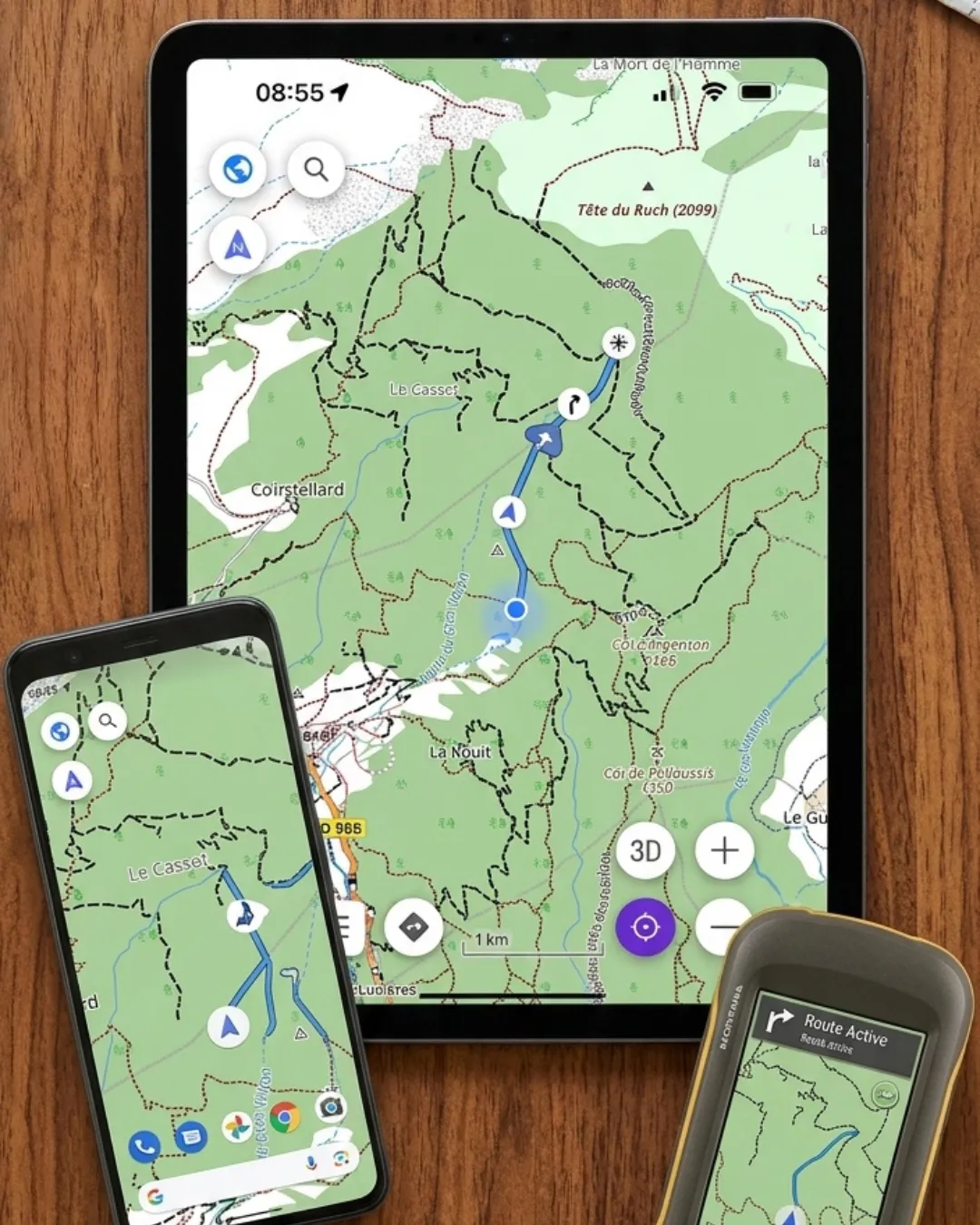
Care far from anywhere
First aid, medicines and hygiene
The health side of the 4×4 essentials checklist is never one to skimp on: far from everything, a well-thought-out kit is one of the 4×4 essentials that makes all the difference.
First aid
We want it reachable in seconds, not buried at the bottom of a bin. Inside: disposable gloves, antiseptic as a solution or wipes, and sterile compresses. For the serious stuff, an emergency hemostatic dressing and a CAT-style tourniquet, the ones that make the difference in a bad bleed, and we really do recommend taking first-aid training to use this kind of kit properly.
For everything else, adhesive dressings and blister plasters, tape, a stretch bandage and a triangular bandage, a survival blanket, a malleable splint, and the little kit of round-tipped scissors, tweezers, a tick remover and a thermometer.
Medicines
To tailor to each person, with prescriptions translated into English (the drug name as its INN). We set off with our personal treatments in sufficient quantity, single-dose saline, a painkiller or antipyretic such as paracetamol, an anti-nausea, an anti-diarrhoeal and a laxative.
We add a high-factor sunscreen and an after-sun cream for sunburn, an antihistamine for bites and allergies, oral rehydration sachets, and, depending on the zone and your doctor’s advice, a broad-spectrum antibiotic on prescription.
Hygiene & health
Hand sanitizer, tissues and masks, an insect repellent (with an anti-malaria treatment if the zone calls for it), your wash bag and a shower towel.
Road safety & legal must-haves
This is the regulatory side, the one a check inspects first. A fire extinguisher reachable from the cabin, one or two warning triangles depending on the country, a high-visibility vest per occupant and a survival blanket. We also keep a Resqme-type window breaker and seatbelt cutter within reach, plus spare bulbs, which are compulsory in some countries.
Four-legged companions: the 4×4 essentials for travelling with a dog
Pixie has her spot on board, a cushion wedged between the seats, and her own line in our 4×4 essentials checklist. Travelling with a dog isn’t something you improvise: she needs her comfort, her food, her papers and a little kit all her own. We pack her bag like ours, with the same care.
For her comfort and daily life, we bring her harness and collar, her lead and long line, a collapsible bowl, kibble or wet food in reserve, a few treats, her favourite toy, her basket or blanket, and a towel for the muddy days. On the health and paperwork side, we keep her health record up to date, her microchip ID, her rabies antibody titration test and her European pet passport. We also put together her own little first-aid kit, always with the vet and never on a hunch: a tick remover, disinfectant, an anti-emetic and something to handle diarrhoea.
The longest part isn’t the gear, it’s the paperwork. Entry rules change from one country to the next, so we look into it ahead of time on Anivet and with our vet to learn the formalities specific to each destination, sometimes several weeks before departure. That’s the price of Pixie travelling with a clear head, and us too.
Paperwork: the 4×4 essentials you can’t afford to rush
It’s the least glamorous of the 4×4 essentials, and yet the one that can hold up a border crossing for hours. On a serious list, you store everything in duplicate, paper and digital, kept separately.
Concretely, we bring the passports, the licences (with an international permit if needed), the registration document, the insurance and, depending on the country, the carnet de passages en douane.
We keep a bit of cash in local currency and in euros or dollars, a few spare passport photos, up-to-date vaccinations with the international certificate if required (yellow fever…), the emergency and embassy contacts printed out, and a copy of the prescriptions, which is precious for medicines at customs.
Don’t forget to warn your bank ahead of time that you’re heading abroad, to avoid finding yourself with a blocked bank card.
Download the 4×4 essentials checklist as a PDF
We’ve put all our 4×4 essentials into a clean, print-ready PDF, with its tick boxes, to slip into the glovebox.
Print the checklist, tick as you prep, adapt the lines to your destination. It’s our method, the same one before every big departure.
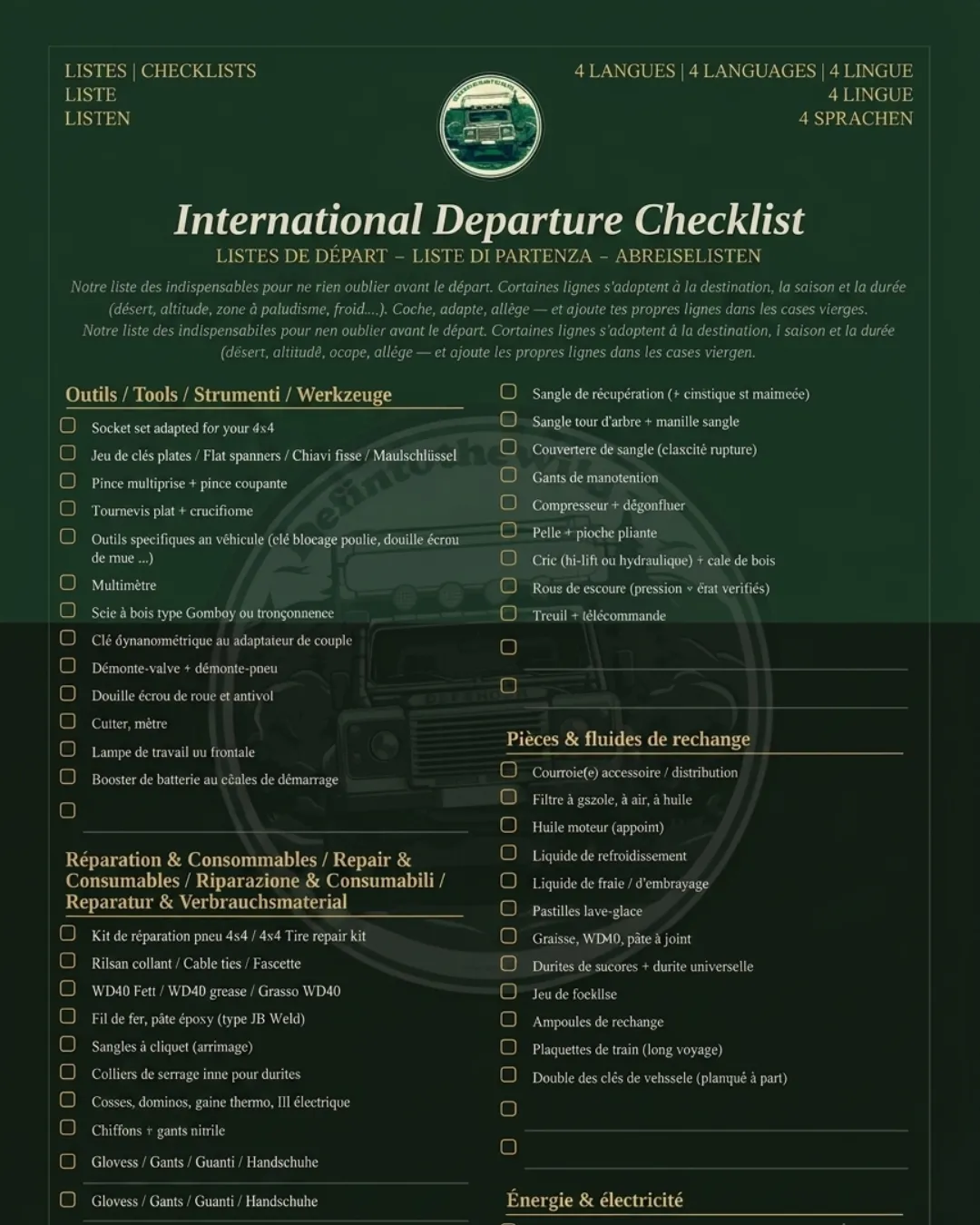 PDF · to tick
 Field-tested routes · GPS
The checklist preps the vehicle, the roadbook preps the route
Once the 4×4 essentials are loaded and the vehicle is ready, the best part is left: the road. To spare you hours of route planning, we’ve gathered our field-tested routes, drivable trails, tracks and GPS coordinates, ready to follow.
Our roadbooks walk you through it step by step, so you can enjoy the trip with a free mind, the way we like to with Pixie on board.
We answer everything
FAQ: the 4×4 essentials checklist
How do I adapt the checklist to my destination?
The base stays the same everywhere: drive, repair, treat yourself. Then you adjust. A desert demands more water, fuel and recovery boards. Altitude calls for a high-altitude kit for the heater and extra vigilance about the cold. A malaria zone adds repellent and treatment. Start from the full list, then remove or reinforce depending on the country, the season and the length of the trip.
Which 4×4 essentials really matter for a road trip?
The core 4×4 essentials come down to a good spare wheel and the tools to change it, a recovery means (boards plus a strap), water and its filtration, a reachable first-aid kit, two offline navigation sources and the vehicle papers. Everything else builds around that core.
Do I really need to carry every tool on the list?
No, the rule we apply: only carry a tool if you know how to use it. The rest just weighs the vehicle down for nothing. That said, even without being a mechanic, keeping a socket set and a few spanners lets a garage guide you from a distance.
Why two navigation sources in the checklist?
Navigation is the one item we systematically double. Because a phone drops, overheats or dies at the worst moment. We always carry offline maps on two different apps and two devices, plus paper maps and a compass. On the trail, never depending on a single source is the rule that avoids the most nasty surprises.
Can you do a 4×4 road trip with a dog?
Yes, we travel with Pixie, our Yorkshire, on the most remote trails. You have to plan ahead: plenty of water, a bowl, a wedged basket, protection from the heat, parasite treatments, an up-to-date vaccination record and a European pet passport. We fold her naturally into our departure prep, and above all we adapt her itinerary.
Where do I get the 4×4 essentials checklist as a PDF?
The full PDF, with its tick boxes, downloads directly from this article via the “Download the PDF” button. Print it, keep it in the glovebox and tick as you prep. To go further, our roadbooks take over once the road has started.